

High-resolution anoscopy (HRA) has moved from niche procedure to essential tool for evaluating anal dysplasia in high-risk populations. When performed well—with methodical technique, proper lighting, and reliable magnification—HRA helps clinicians visualize acetowhite and vascular changes that standard anoscopy can miss. Your optics matter. Below is a practical guide to HRA plus how Seiler’s colposcope lineup supports consistent, high-quality exams.
What is HRA—at a glance
HRA combines:
-
Magnification to inspect the anal canal and perianal skin.
-
Bright, coaxial illumination to reveal subtle color and vascular changes.
-
Contrast agents (commonly 3–5% acetic acid; Lugol’s as appropriate).
-
Targeted biopsy of suspicious lesions.
Because pathology can be subtle—flat acetowhite change, punctation, mosaicism—stable optics, even light, and ergonomic positioning are critical.
What to look for in an HRA colposcope
-
Optics: German Schott Glass lenses and crisp edge-to-edge clarity reduce eye strain and support confident biopsies.
-
Magnification: quick changes between overview and close-up (typical working range ~6x–20x+).
-
Illumination: high-intensity, cool LED with coaxial beam; the red-free (green) filter enhances visualization of vascular patterns.
-
Ergonomics & balance: smooth easy maneuverability with gas piston technology.
-
Imaging: camera accessories available for teaching and documentation.
-
Service & longevity: dependable quality and minimizing downtime.
How Seiler colposcopes fit HRA
Seiler 935 — Vertical Post Design – Dependable Workhorse
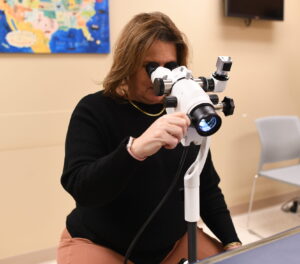
The Seiler 935 is a budget-friendly workhorse:
-
3-steps of magnification for fast transitions from survey to detail.
-
Bright LED illumination that stays cool and consistent through long clinics.
- Small diameter base on roller castors with adjustable vertical post height.
-
Green (red-free) filter for increased contrast of vascular systems.
Seiler 955 — Swing Arm Technology – Industry Favorite
The Seiler 955 adds refinements that matter when you’re doing higher volumes:
- 5-steps of magnification with expanded optics to see every detail.
- Bright LED illumination that stays cool and consistent through long clinics.
-
Swing arm technology for ease of use and reducing obstruction in the working distances.
- Green (red-free) filter for increased contrast of vascular systems.
Seiler 985 — Over-the-Sholder Versatility – Clear User Field
When the most challenging HRA cases are on your schedule, the Seiler 985 shines: 
- 5-steps of magnification with expanded optics to see every detail.
- Bright LED illumination that stays cool and consistent through long clinics.
- Over-the-Shoulder to remove any obstructions from the user’s field.
- Green (red-free) filter for increased contrast of vascular systems.
Practical HRA workflow (equipment-centric)
-
Room setup
-
Position the colposcope so the optical axis is coaxial with the anal canal; ensure you can adjust height and angle without repositioning the patient.
-
Connect camera output (if used) to a monitor within your line of sight and confirm recording settings.
-
-
Lighting & contrast
-
Start with lower magnification and moderate LED intensity for orientation.
-
Engage the green (red-free) filter to assess vascular changes when needed.
-
Increase magnification for suspicious areas; avoid excessive light that can wash out subtle acetowhitening.
-
-
Application of acetic acid (± Lugol’s)
-
Wait the appropriate interval for reaction to develop; scan systematically (quadrants or clock-face).
-
-
Targeted biopsies
-
Lock the stand; use your foot controls to refine focus hands-free.
-
Document with stills or short video clips through a Seiler-compatible camera for tracking and QA.
-
-
Post-procedure documentation
-
Export images to the EHR or secure archive; establish a naming protocol to streamline follow-up.
-
Building your HRA service line: what you’ll need
-
Colposcope: Decide the model that fits budget and needs.
-
Imaging path: Camera + image/video capture device.
-
Draping & infection control: Compatible sterile drapes for the head/arm and cable management.
-
Documentation workflow: Standardized photo protocol and storage.
FAQs
Is a red-free (green) filter necessary for HRA?
It’s not mandatory, but it’s extremely helpful. The filter enhances contrast in vascular patterns—useful for characterizing atypical vessels.
What magnification range should I plan on?
Clinicians often work between a wide overview (single-digit magnification) and detailed inspection (teens to low 20s). The key is stable focus and easy switching.
Do I need a camera from day one?
Not strictly, but teaching, QA, and longitudinal tracking are much easier with photo/video capture. Seiler systems can attach camera accessories so you can add imaging later if you prefer.
Bring sharper HRA to your Clinic or Practice Today!
Ready to tailor an HRA-optimized setup? We can help spec the right Seiler colposcope, camera pathway, filters, and capture workflow for your room layout and budget.
Request a live demo or quote for the Seiler 935, 955, or 985.
Let’s make subtle lesions obvious—and elevate your HRA program with Seiler optics.